

© 2004
The Revision of the EWC Directive

In the year 1999 the Directive on European Works Councils (EWC Directive) should be revised. However the European Commission started the revision procedure only in April 2004 and the second stage of consultations in March 2005. A study of Manchester University, UK, published in November 2005, using the interview results of more than 470 EWC members shows the need for the legislator to act. In September 2006 the European Economic and Social Committee (EESC) voted with majority in favor of a revision of the EWC Directive and put the European Commission under pressure. This presented finally a bill on July 2nd, 2008 which has become effective on June 5th, 2009.

The past history

The valid EWC Directive dates of the year 1994 and intended a revision in article 15 already for 1999. This issue has a high priority for trade unions, so the European Trade Union Confederation (ETUC) presented precise change suggestions on the directives' wording already in December 1999.

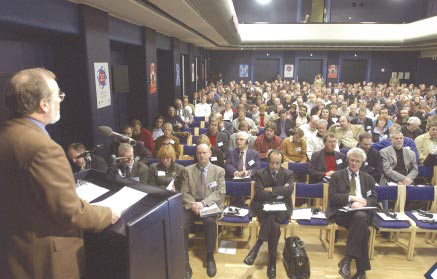
FotoFoto In November 2002, the ETUC organized a conference in Århus (Denmark) under the motto "Towards more influence", in which several hundred EWC members and trade union officials from all over Europe took part (see photo). They discussed about the role of the European Works Councils in restructuring cases, about the improvement of the information and consultation procedures as well as about the legal inforcement of the EWC rights. The detailed meeting report lists numerous case studies and summarizes the discussions.
Report of the EWC conference in Århus
(November 2002)

At this meeting the European Commission had announced a revision of the EWC directive. At first it wanted to wait for a statement over the practical application of the EWC directive of the European Economic and Social Committee (EESC), however. The EESC is a consultative body of the EU which consists of representatives of the employers, the employees and other groups. This statement which has been available since September 2003 could therefore be only a compromise of different interests and provide a rather neutral look at the topic. Though the paper is the first assessment of the EWC directive since 1994 which was worked out by employer and employees' side jointly.

Opinion of the European Economic and Social Committee
(September 2003)

However, this statement changed nothing at the fundamentally different opinions. While trade unions require an expansion of the EWC information and consultation rights, the employers block any change. For example the European employers' organisation for the metal, engineering and technology based industries (WEM) stated that a revision of the EWC Directive would come too early and wouldn't be necessary in the course of EU enlargement.

Position paper of the European employers' organisation for the metal and engineering industries
(November 2003)

The European Trade Union Confederation (ETUC) had rendered its demands to the amendment of the EWC Directive more precisely in a strategy paper covering 26 points in February 2004. It contains important aspects for the improvement of the EWC work, however, is regarded as a "pious list of things desired" by many against the background of the political power conditions. Some voices within the trade unions demand a concentration on select main points for the amendment, what is more beneficial than maximum demands with which one would push at the employers' federations "on granite".

Strategy paper of the European Trade Union Confederation
(February 2004)

The beginning of the legislation process

On April 20th, 2004 the European Commission invited the social partners - the European Trade Union Confederation (ETUC) and the European employers' federations - officially for a statement and started the legislation process on the revision of the EWC Directive with that. An abstract of the reasons for the hearing is found in the press release of the European Commission.

The consultation of the European Commission
(April 20th, 2004)

The questions to the social partners referred primarily to
  • how best the potential of European works councils can be fully realised
  • in which direction the EU could get active and
  • which role the social partners themselves could primarily play.

    With the last question the European Commission wanted to sonder whether the social partners are willing to present a common, independent suggestion on a new version of the EWC directive. An invitation for such negotiations had left without resonance sometimes within the years before 1994 because the employers' organisations - especially the British CBI (Confederation of British Industry) - regarded an EWC directive simply as superfluous. Meanwhile the official answers of the social partners are available:

  • Statement of the European Trade Union Confederation (ETUC)
    (May 19th, 2004)
    Statement of the Union of Industrial and Employers’ Confederations of Europe (UNICE)
    (June 1st, 2004)

    In their statements the employers voiced in favor of the start of negotiations with the trade unions, they don't want a change at the wording of the law, though. Practical points of reference or guidelines for the enterprises shall be developed into the application of the existing Directive instead. They demanded of the European Commission to stop the second round of the consultations.

    At first the social partners reached an agreement on June 23rd, 2004 to discuss case studies about the work of European works councils on two events. These so-called "social partner seminars" took place in Brussels on September 23/24th and on October 27/28th, 2004. The presented case studies were then evaluated by a working group formed from six representatives of the employers and the trade unions each. On March 1st, 2005 they presented a thesis paper which summarized the most important aspects and the detailed description of all case studies followed on March 17th, 2005. The ETUC executive committee took position from the trade union view on 15/16 March 2005.

    The evaluation of the social partner seminars
    (March 1st, 2005)
    Statement of the ETUC on the evaluation of the social partner seminars
    (March 15/16th, 2005)
    The description of the case studies in the wording
    (March 17th, 2005)

    Beginning of the second stage of the legislation procedure

    FotoFoto The new EU commissioner for employment and social affairs, Vladimír Špidla, had approved a revision of the EWC Directive already on September 27th, 2004 during a hearing of the European Parliament in the context of his nomination (see photo). Špidla, who took up his office on November 22nd, 2004 wanted to start the second stage of the consultations as part of the legislation process as soon as the evaluation of the social partner seminars would be ready.

    After the European Trade Union Confederation had asked Špidla in writing on January 14th, 2005 to accelerate the legislation procedure (see press release), the European Commission presented a paper on March 31st, 2005 which is regarded as the second round of the consultations.

    In a communication compounding 15 pages it commented on the topics "European Works Councils" and "restructurings" and requested to the European social partners,

    "to intensify ongoing work and to start negotiations with a view to reaching an agreement among themselves on the requisite ways and means for promoting best practice in the way that European works councils operate, with a view to making them more effective, more especially as regards their role as agents for change".

    Communication of the European Commission
    (March 31st, 2005)

    The social partners commented on this in the middle of July 2005. The European employers' confederation UNICE still argues, the legislation procedure is neither desirable nor necessary. The European Trade Union Confederation (ETUC) would like to come to the adoption of an improved Directive as quickly as possible and therefore finds fault, that there is a lack of a concrete deadline on the part of the European Commission and no suggestion were made of it with regard to the contents to a new EWC Directive. Furthermore the ETUC criticizes the combination of legislation procedures regarding "European works councils" and "restructurings". An EWC doesn't only deal with restructuring issues and restructuring is no exclusive EWC topic - so the central statement of the ETUC.

    Statement of the Union of Industrial and Employers’ Confederations of Europe (UNICE)
    (July 14th, 2005)
    Statement of the European Trade Union Confederation (ETUC)
    (July 14/15th, 2005)

    The European Parliament intervened in the debate on January 26th, 2006. The Committee on Employment and Social Affairs

    "regrets that the second phase consultation on the European Works Council is only a minor subchapter encompassed in a broader Commission Communication, and calls on the Commission ... to launch a proper second phase consultation offering social partners the opportunity to negotiate."

    Report of the European Parliaments' Committee on Employment and Social Affairs
    (January 26th, 2006)

    A demand of the European Trade Union Confederation (ETUC) was taken up with that. The report shall soon be approved as a resolution in the plenum of the European Parliament. If the employers still decide to start negotiations with the trade unions anyway, then they have nine months time for it. If they reach a joint regulation, this text will become effective as a new EWC Directive with a great probability.

    During the Social Summit on March 23rd, 2006 in Brussels representatives of the European Trade Union Confederation (ETUC) and the European employers' federations presented their joint work programme for the years 2006 - 2008 to the governments of the EU countries. Although issues like strengthening the social dialog in central and Eastern Europe or dealing with company restructurings are named, a decisive point is missing: the revision of the EWC Directive is no topic. On the same day the European employers' confederation UNICE presented a study which shows how employers and employee representatives deal with restructurings in different countries.

    Report of the social summit on March 23rd, 2006
    Work Programme of the European Social Partners 2006-2008
    UNICE report on restructuring
    (March 23rd, 2006)

    A new study shows the need for the legislator to act

    Prof. Dr. Jeremy Waddington from the University of Manchester presented first results of a large-scale examination to a conference of the European Trade Union Confederation (ETUC) in Brussels on November 4th, 2005. On behalf of several European trade union federations he had questioned more than 470 members in 196 European works councils out of all industry sectors from 24 countries about the problems arising in their EWC. This study shows where European works councils are dependent on improved framework conditions and support.

    The minimum requirements on information and consultation as specified in the Directive are not being met - so the central statement of Prof Waddington. As a result, the intentions of the legislator regarding information and consultation in multi-national companies are not being implemented in practice.

    Interview with Prof Dr Jeremy Waddington
    (during the conference on November 4th, 2005 in Brussels)
    Summary of the research results
    (4 pages)
    Statistical data of the survey
    (21 pages)

    European Economic and Social Committee demands revision of the EWC Directive

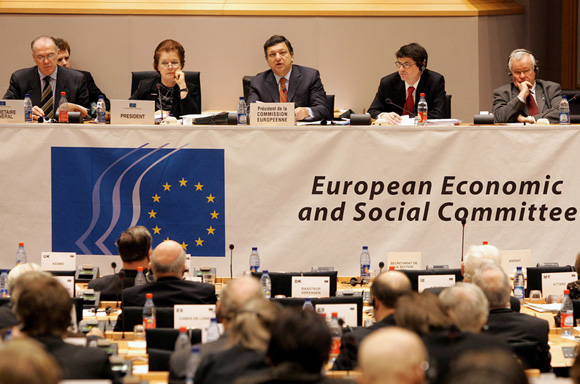
    FotoFoto On September 13th, 2006 the European Economic and Social Committee (EESC) decided in Brussels on an opinion under the title "European Works Councils: a new role in promoting European integration" initiated by the trade unions' side. The text contains the clear demand for a revision of the EWC Directive, what is declined by employers' side vehemently. The decision therefore means a sharp defeat for the employers' federations. Even if decisions of the EESC aren't definite, the European Commission is now under political pressure to present a wording for a new EWC Directive.

    The opinion of the EESC in the wording
    (21 pages)

    FotoFotoEuropean Parliament also demands revision of the EWC Directive

    The European Parliament in Strasbourg demanded in a resolution on May 10th, 2007 to update the legal provisions for information and consultation and particularly the EWC Directive. The EU Commission shall present a concrete time schedule. Already on April 25th, 2007 a discussion took place whereby several Members of Parliament used current examples like Airbus, Alcatel-Lucent, Delphi Systems and Volkswagen to highlight the need for action of the legislator.
    The debate in the European Parliament
    The resolution of the European Parliament in the wording

    Trade unions increase the demand for a revision

    Shortly before the debate in the European Parliament and exactly three years after the beginning of the revision procedure the European Trade Union Confederation (ETUC) convened about 200 European works council members for a meeting in Brussels on April 20th, 2007. In the presence of Social Commissioner Špidla and the European employers' confederation BusinessEurope they stressed the demand for a revision of the EWC Directive. During this meeting a documentation on methods of action for European works councils in the course of restructuring was presented, covering cases like General Motors, InBev, RWE Energy and Dim Branded Apparel.

    ETUC press release about the meeting
    The documentation about EWC methods of action

    The ETUC congress, which met in Seville (Spain) from May 21st to 24th, 2007 also asked for strengthening the European works councils. It named the key activities in a manifesto:

    "fight delocalisation, stimulate negotiations on restructuring and provide a stronger framework of information, consultation and involvement, including involving independent experts on restructuring."

    The ETUC Seville Manifesto in the wording

    Interview with the person in charge of EWC at the European Trade Union Confederation (ETUC)

    FotoFoto At the congress the head of the ETUC was regularly newly-elected. Since then the Deputy General Secretary Reiner Hoffmann (photo) from Germany is responsible for the topic employee participation, which also includes the European works councils. In the interview with EWC News he explained the demands of the trade unions on the legislator.

    The interview with Reiner Hoffmann


    ETUC conference in Barcelona

    Under the motto "European Works Councils - in Europe and Beyond" the ETUC had invited to a conference from June 29th until July 1st, 2004 in Barcelona. A study compounding 81 pages on the revision of the EWC directive was presented there.


    Download of the documentation


    Our service:

    The members of the Training and Consulting Net "euro-workscouncil.net" are available to inform about the legal situation and show possibilities of an improvement in the EWC agreement in your next EWC meeting. In a survey among German EWC members we had collected in summer 2004 numerous points which are particularly important to practitioners.

    List of points desired for the revision
    (Survey among EWC members in summer 2004)


    Top
    Diese Seite in deutscher Sprache
    Cette page en francais
    Home
    Service
    Team
    Documents
    Links
    Contact